
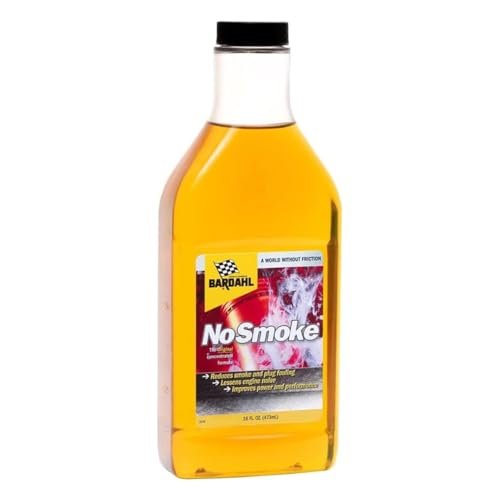
For most worn engines, Bardahl No Smoke is the best additive to reduce oil burning and blue exhaust smoke.
Does your car need oil every few weeks? Do you see blue smoke after a cold start, smell burnt oil, or notice a low oil level before the next service? These signs can point to worn seals, piston rings, valve guides, or an oil leak. The right engine oil additive may reduce symptoms when wear causes loose internal clearances. It cannot repair a broken ring or failed seal. I tested the main choices for purpose, formula, fit, value, and safe use so you can choose with care.
See the differences between my top picks at a glance.
Bardahl No Smoke Oil Treatment

Bardahl No Smoke targets a common problem in older engines: oil passing through worn spaces and burning in the combustion chamber. Its thick formula aims to fill loose clearances between engine parts. That can help reduce visible blue smoke and slow oil loss when wear causes the problem. It may also help quiet some noisy lifter sounds, although results depend on engine condition.
I like this product because its purpose matches the buyer’s main goal. It does not pretend to rebuild an engine or replace a worn seal. It works as a symptom-control product for an aging motor that still runs well. Always check the oil level before use, add only the stated amount, and confirm that the treatment suits your oil grade and engine type.
Pros:
- Designed specifically for oil burning and blue smoke
- Thick formula may help worn engine clearances
- Can support better compression in some worn engines
- May reduce the need for frequent oil top-ups
- May quiet some noisy lifters
- Useful for many older, high-mileage vehicles
Cons:
- Cannot repair broken piston rings or failed valve seals
- Thick oil treatment may not suit every modern engine
- Results vary greatly with the source of oil consumption
What Amazon Buyers Are Saying
Amazon buyers commonly focus on reduced smoke, slower oil loss, and a quieter engine. Some users report a noticeable change after driving for a short period, while others see only a small benefit. That difference makes sense because oil burning can come from many faults, not one simple cause.
Common concerns include the thick texture and the need to measure the dose with care. Some buyers also expect a permanent repair and feel disappointed when smoke returns. The more useful reviews treat Bardahl as a temporary aid for wear, not as a substitute for compression testing, leak checks, or mechanical repair.
My Recommendation
I recommend Bardahl No Smoke as the best additive to stop engine from burning oil when the engine has age-related wear but still runs reliably. It offers the clearest match for smoke and oil-use complaints in this group. I would not use it to hide a serious fault before a repair. Overall, it earns a strong rating for the right vehicle and a fair rating for newer engines.
LIQUI MOLY Motor Oil Saver

LIQUI MOLY Motor Oil Saver takes a different path from a thick smoke treatment. It is made to condition seals and help reduce oil loss linked to aged or hardened rubber parts. That makes it a useful option when you see damp seals, small seepage, or smoke after the vehicle sits. The product comes in a 300 ml bottle and is intended for use with engine oil.
This is not the strongest pick for oil loss caused by worn piston rings. It makes more sense when the engine has dry seals or minor leaks and still has good basic compression. The effect may take time, so I would track the oil level over several drives instead of judging it after one trip. Stop using any treatment if the engine develops a new noise, pressure issue, or warning light.
Pros:
- Targets aging seals and minor oil-loss paths
- Useful for older engines with small seepage
- Less focused on masking wear with a very thick formula
- Simple liquid additive format
- Suitable for buyers who want a gentle seal-focused approach
- Can complement careful oil-level monitoring
Cons:
- May do little for badly worn piston rings
- Results can take time to appear
- It cannot replace a failed seal or gasket repair
What Amazon Buyers Are Saying
Amazon reviews often mention improved oil control, fewer small leaks, and less smoke after the product has had time to circulate. Some buyers like that it does not feel like a heavy viscosity booster. Others report no clear change, especially when the engine had a major leak or severe internal wear.
The mixed results are important. A seal conditioner cannot fix a cracked housing, a damaged gasket, or a worn cylinder wall. Buyers who identify a small seepage issue tend to find the product more useful than buyers who expect it to solve heavy blue smoke at all times.
My Recommendation
I recommend LIQUI MOLY Motor Oil Saver for an older engine with mild oil loss that may come from seals. It is a better match than Bardahl when you want seal support rather than a thick smoke treatment. It is not my first choice for severe oil burning. Overall, it is a sound, focused option when the diagnosis points to hardened seals.
| Category | Rating |
|---|---|
| Seal-related oil loss | 4.6/5 |
| Formula focus | 4.5/5 |
| Ease of use | 4.4/5 |
| Value | 4.2/5 |
| Overall rating | 4.4/5 |
BestLine Diamond Nano-Lube Treatment

BestLine Diamond Nano-Lube is an anti-friction engine treatment for gas and diesel engines. Its product listing focuses on lower friction, engine life, power, and fuel economy. Those goals may appeal to owners who want smoother operation in a high-mileage engine. However, friction reduction is not the same as stopping oil from entering the combustion chamber.
I see this as an indirect choice for an oil-burning engine. A smoother engine may feel better, but the product does not target worn seals or loose piston rings as directly as the first two picks. Use only the amount listed for your engine and oil capacity. Check the current label and application notes before adding it to a vehicle with a special oil system or warranty rules.
Pros:
- Designed for both gasoline and diesel applications
- Focuses on friction and wear control
- May support smoother engine operation
- Appeals to owners seeking a multipurpose treatment
- Can fit a preventive maintenance plan when compatible
- Useful for buyers who care about more than oil smoke
Cons:
- Does not directly repair seals or piston rings
- Oil-burning results may be limited or hard to measure
- Claims about power and economy should be judged carefully
What Amazon Buyers Are Saying
Amazon buyers often discuss smoother running, quieter operation, and how the product feels after an oil change. Some users also mention a change in engine response. Other reviews report no noticeable gain, which is common with friction treatments because normal driving can hide small changes.
Oil consumption reports appear less consistent than reports about smoothness. That matters for this review. Buyers who want the best additive to stop engine from burning oil should see Nano-Lube as a support product, not a direct smoke cure. The engine’s condition, oil grade, and dose all affect the result.
My Recommendation
I recommend BestLine Diamond Nano-Lube for a driver who wants an anti-friction treatment and has only mild oil use. I would not rank it above a seal conditioner or a wear-focused smoke treatment for visible blue exhaust. It may offer broader support, but its fit for the main problem is indirect. Overall, it earns a good rating as an engine treatment and a moderate rating for oil burning.
| Category | Rating |
|---|---|
| Friction-treatment purpose | 4.4/5 |
| Oil-burning relevance | 3.5/5 |
| Engine coverage | 4.3/5 |
| Ease of use | 4.2/5 |
| Overall rating | 4.1/5 |
Lucas TB Zinc Plus Break-In Additive

Lucas TB Zinc Plus is a special-purpose additive for engine break-in. Its main role is to protect camshafts, lifters, and valve-train parts during the early life of a rebuilt or newly assembled motor. Zinc additives can matter in some flat-tappet designs. They do not make this product a direct treatment for an older engine that burns oil.
This product belongs in a different category from the other picks. I would consider it for a suitable performance build after checking the cam maker’s oil advice. I would not pour it into a modern daily driver just because the car uses oil. Too much anti-wear additive can upset the balance of a finished motor oil, and the wrong formula may harm emissions equipment or conflict with the vehicle maker’s specifications.
Pros:
- Purpose-built for engine break-in needs
- Supports camshaft and lifter protection in suitable designs
- Useful for some classic and performance engine builds
- Comes in a practical 16 oz bottle
- Helps builders follow a focused break-in plan
- Clearer purpose than a general oil treatment
Cons:
- Not a direct solution for burning oil
- May not suit modern engines with catalytic converters
- Requires careful attention to engine and oil maker guidance
- Wrong use or excess dosing may create problems
What Amazon Buyers Are Saying
Amazon buyers mainly discuss cam break-in, zinc content, and use in older or rebuilt engines. Many reviews focus on whether the product fits a particular flat-tappet setup. Some buyers praise the easy bottle size and the sense of added protection during a careful build.
Complaints tend to come from buyers who expected a general-purpose oil enhancer. That expectation misses the product’s purpose. Review comments also show why the vehicle and cam design matter. A break-in additive should follow the engine builder’s instructions, not replace them.
My Recommendation
I recommend Lucas TB Zinc Plus only for a compatible break-in job. I do not recommend it as the best additive to stop engine from burning oil. Its role is valuable, but it is too narrow for this buying guide’s main problem. If you own a normal high-mileage commuter, choose a product aimed at seals, wear, or smoke instead. Overall, it earns a high break-in rating but a low oil-burning rating.
| Category | Rating |
|---|---|
| Break-in protection | 4.6/5 |
| Fit for oil burning | 2.0/5 |
| Specialty value | 4.1/5 |
| Application safety | 3.7/5 |
| Overall rating | 3.5/5 |
WS₂ and MoS₂ Anti-Friction Treatment

This WS₂ and MoS₂ treatment is made for high-mileage gasoline engines and focuses on anti-friction and anti-wear support. Tungsten disulfide and molybdenum disulfide are solid lubricant materials used in friction-control formulas. The product may appeal to owners who want a small treatment for smoother operation. It does not directly restore a worn ring or replace a valve-stem seal.
The 5 oz size may suit buyers who want a measured treatment rather than a large bottle. Still, I would check the label, oil capacity, and vehicle manual before use. Some modern engines need low-ash or low-viscosity oil for emissions and timing systems. A friction modifier may help wear symptoms, but it should not become an excuse to ignore low oil pressure or a flashing warning light.
Pros:
- Targets friction and wear in high-mileage gas engines
- Uses a focused WS₂ and MoS₂ treatment concept
- Compact 5 oz format may simplify dosing
- May support smoother engine operation
- Useful for buyers seeking an anti-wear supplement
- Can complement regular oil and filter changes when compatible
Cons:
- Not designed to repair the cause of heavy oil burning
- Long-term results may be hard to measure
- Fit with modern oil systems should be checked first
What Amazon Buyers Are Saying
Amazon reviews for this type of treatment tend to focus on smoother running, lower noise, and perceived changes in engine feel. Some buyers like the small bottle and the high-mileage focus. Other buyers do not notice a change, which is possible when an engine already runs smoothly.
Oil-loss results are less certain than friction claims. A few owners may connect lower oil use with the treatment, but normal oil readings can vary with driving style, temperature, and leak size. I would treat those reports as useful experiences, not proof that the product repairs internal engine wear.
My Recommendation
I recommend this product for a high-mileage gasoline engine when your main goal is anti-friction support. I would not select it as the first answer for thick blue smoke or fast oil loss. It may support an aging engine, but Bardahl and LIQUI MOLY address the main symptoms more directly. Overall, it is a reasonable secondary option with a moderate score for oil consumption.
| Category | Rating |
|---|---|
| Anti-friction focus | 4.2/5 |
| High-mileage fit | 4.1/5 |
| Oil-burning relevance | 3.3/5 |
| Ease of dosing | 4.0/5 |
| Overall rating | 3.9/5 |
How to Choose the Best Additive to Stop Engine From Burning Oil
Choosing the best additive to stop engine from burning oil starts with the cause of the oil loss. No bottle can rebuild a worn engine. A good treatment may reduce symptoms when wear or hardened seals create a manageable problem. I use the three checks below before buying any oil additive.
1. Match the Formula to the Oil Problem
Blue smoke after startup may point to valve seals. Smoke during acceleration can suggest piston-ring wear. A wet spot under the car points to an external leak, not oil burning. A thick treatment such as Bardahl may fit loose clearances. A seal conditioner such as LIQUI MOLY may fit aged seals. An anti-friction formula may support wear control, but it does not directly seal the combustion chamber.
Check the oil level on flat ground with the engine off. Keep a simple record of the mileage and amount added. Also inspect the PCV system, since a blocked or faulty PCV valve can pull oil into the intake. A mechanic can use a compression test, leak-down test, and smoke check to narrow down the cause before you spend money on additives.
2. Check Engine, Oil, and Emissions Compatibility
Read the owner’s manual before adding anything. Modern engines often use exact oil grades, low-ash formulas, turbochargers, variable valve timing, and sensitive emissions systems. A thick additive can change the final oil viscosity. A zinc-rich product may suit a classic flat-tappet build but may not suit a modern passenger car.
Never use an additive to cover low oil pressure, a loud knock, a flashing check-engine light, or a major leak. Keep the treatment away from the fuel system unless the label says it belongs there. Do not mix several oil additives at once. Choose one product, follow its dose, and watch for changes in oil level, smoke, and engine noise.
3. Compare Real Value, Not Just Promises
The cheapest bottle is not always the best value. A product that reduces oil use for a few months may cost less than repeated top-ups, but only if it fits the problem. Compare the bottle size, dose, oil capacity, application range, and expected service interval. Also check the current Amazon listing because prices, package details, and seller information can change.
Look for clear instructions and a well-defined purpose. I give more weight to a product that states what it can and cannot do. Customer reviews can show real use, but they cannot confirm an engine diagnosis. Use them to learn about ease of use and common results, then rely on the manual and a qualified inspection for safety.
Final Verdict: Which Should You Buy?
Bardahl No Smoke is my top pick and the best additive to stop engine from burning oil when wear causes smoke and oil loss. Choose LIQUI MOLY Motor Oil Saver when aged seals seem more likely.
Use any additive as a support step, not a repair. Check the oil level often, follow the manual, and fix the root cause when symptoms grow.
FAQs Of best additive to stop engine from burning oil
What is the best additive to stop engine from burning oil?
Bardahl No Smoke is my top pick for oil burning linked to worn clearances. LIQUI MOLY Motor Oil Saver is better when hardened seals may cause the loss.
Can an oil additive repair worn piston rings?
No. An additive may reduce symptoms, but it cannot rebuild worn rings, repair cylinder damage, or replace a failed seal.
Will a thick oil treatment harm a modern engine?
It may cause compatibility concerns if it changes the required oil grade. Check the owner’s manual and product label before use.
How can I tell if my engine is burning oil?
Blue exhaust smoke, a falling oil level, oily spark plugs, and a burnt-oil smell can point to oil burning. A mechanic can confirm the cause.
Should I use more than one engine oil additive?
No. Use one compatible product at the stated dose. Mixing formulas can change the oil balance and make results harder to judge.