The best convertible car seat for seat belt installation is the Safety 1st Grow and Go All-in-One.
Picture a busy parent moving a child from one car to another. The child needs a safe seat, but the vehicle may not have lower anchors in the right place. A seat belt installation can solve that problem when you route the belt through the correct path and lock it tightly. I reviewed the listed products for fit, use, value, and installation needs. Two are actual child restraints. The other two are seat belt pad accessories, not car seats. That difference matters. A soft pad cannot replace a tested car seat or improve an incorrect installation.
See the differences between my top picks at a glance.
| Product | Primary use | Child seat stages | Seat belt relevance | Best for | Buy |
|---|---|---|---|---|---|
| Safety 1st Grow and Go, Black Phantom | All-in-one car seat | Rear-facing, forward-facing, booster | Designed for vehicle-belt use by stage | Long-term value | View on Amazon |
| 2PCS Car Seat Pads | Shoulder belt comfort pad | No child-seat stages | Comfort only; not an installation aid | Adult belt comfort | View on Amazon |
| 2 Pack Universal 3-Point Pads | Belt pad accessory | No child-seat stages | May cushion a belt; does not secure a seat | Go-kart or vehicle comfort | View on Amazon |
| Safety 1st Grow and Go, Alaskan Blue | All-in-one car seat | Rear-facing, forward-facing, booster | Designed for vehicle-belt use by stage | Blue color option | View on Amazon |
Safety 1st Grow and Go All-in-One

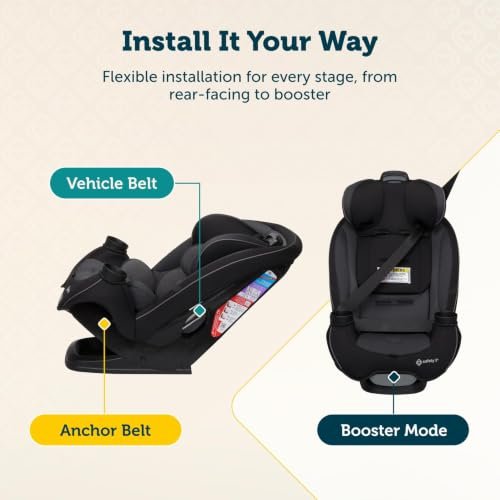
The Safety 1st Grow and Go All-in-One is the strongest match in this group for parents who want a convertible car seat that can use a vehicle seat belt. The listed model covers rear-facing use from 5 to 40 pounds, forward-facing use from 30 to 65 pounds, and belt-positioning booster use from 40 to 100 pounds. Those limits make it a long-use option rather than a seat for one short stage. The Black Phantom cover also gives it a simple look that should suit many interiors.
For a seat belt installation, the most important step is not the color or the number of stages. It is using the correct belt path for the current mode. I would read the car seat manual and the vehicle manual before installing it. The seat must sit flat, the belt must pass through the correct opening, and the installed seat should not move more than one inch at the belt path when tested side to side and front to back.
Pros:
- Three useful stages in one child restraint
- Rear-facing range starts at 5 pounds
- Forward-facing range reaches 65 pounds
- Booster mode extends use to 100 pounds
- Works with a vehicle seat belt when installed as directed
- Can reduce the need to buy several seats over time
- Black Phantom is a practical, low-key color
Cons:
- An all-in-one seat may feel larger than a single-stage seat
- Correct belt routing takes careful reading of the manual
- Booster readiness depends on the child’s fit and maturity, not weight alone
What Amazon Buyers Are Saying
Available buyer feedback for this type of Grow and Go model tends to focus on its broad weight range and the value of getting several stages in one purchase. Parents often look for a seat that can stay with a child through rear-facing, forward-facing, and booster use. The simple cover design also appeals to buyers who want a basic look.
The main concerns buyers raise with all-in-one seats usually involve size, belt routing, and adjustment learning. A parent may find the first installation slower than expected. That is not a reason to skip the seat, but it is a reason to set aside time for the manual, check the fit, and use a certified child passenger safety technician when needed. Product reviews cannot replace an in-person fit check.
My Recommendation
I recommend this model as the best overall choice here for a family seeking the best convertible car seat for seat belt installation. It offers the clearest long-term use among the listed products. I would buy it only after checking its current manual, your vehicle belt system, and your child’s size. Its value is strongest for families who want one seat with three stages.
| Category | Rating |
|---|---|
| Seat-belt installation potential | 4.5/5 |
| Stage coverage | 4.5/5 |
| Practical value | 4.5/5 |
| Ease of use | 4/5 |
| Overall rating | 4.5/5 |
2PCS Car Seat Pads Shoulder Extenders

The 2PCS Car Seat Pads Shoulder Extender Interior Accessories are not convertible car seats. They are small comfort accessories for a shoulder belt or interior contact point. The listing name suggests a two-piece set, but it does not provide the child restraint structure, harness, shell, or booster function needed to protect a child. I include it because it appears in the supplied product group, but it should not be mistaken for the best convertible car seat for seat belt installation.
This type of pad may help reduce rubbing against an adult’s neck or shoulder. It does not secure a child restraint to a vehicle. It also does not correct a loose belt, poor belt angle, wrong harness height, or poor booster fit. If you use a comfort pad, keep it away from the harness system unless the car seat maker clearly allows it. Added items can change how a restraint contacts the child or seat.
Pros:
- Small and easy to carry between vehicles
- Two pieces may suit more than one belt position
- Can add cushioning for some adult belt users
- May help reduce belt rubbing on clothing or skin
- Usually takes little time to place on a belt
- Useful as a comfort accessory when used for its intended purpose
Cons:
- It is not a convertible car seat
- It cannot replace a harnessed child restraint or booster
- It does not improve the tightness of a car seat installation
- It may not fit every belt design or vehicle seat
- It should not be placed under or around a child-seat harness without approval
What Amazon Buyers Are Saying
Buyer feedback on belt pads commonly centers on softness, ease of use, and whether the pad stays in place. Some shoppers seek a simple way to make a shoulder belt more comfortable during daily driving. Others find that fit and personal comfort vary by belt width, clothing, and seat position.
The key point is that comfort reviews do not measure crash protection. A soft belt cover can feel pleasant, yet it cannot make an incorrect child-seat installation safe. Before buying, I would confirm that the item fits the intended belt and use it only for comfort. I would also keep the child seat’s harness and belt path exactly as shown in the restraint manual.
My Recommendation
I would not recommend this product as a car seat purchase. It may be worth considering as an adult comfort pad, but it does not compete with a real convertible restraint. If your goal is a vehicle-belt installation, spend your budget on a tested child seat and a proper fit check. This product earns a low rating for the requested category because it serves a different purpose.
| Category | Rating |
|---|---|
| Child-seat function | 1/5 |
| Belt comfort use | 3.5/5 |
| Installation support | 1/5 |
| Category value | 2/5 |
| Overall rating for this category | 1.5/5 |
Universal 3-Point Seat Belt Pads

The 2 Pack Universal 3-Point Seat Belt Pads is another accessory, not a convertible car seat. Its title lists use with a go-kart, golf cart, UTV, or minivan. That broad wording may appeal to shoppers who want extra padding on a three-point belt. Still, the product does not provide a child shell, harness, recline system, or belt-positioning booster function.
I see a possible comfort role for this set in the right adult vehicle application. I do not see a role in installing a child restraint. A seat belt must hold the child seat at the approved belt path, and the belt must remain flat and tight. A pad placed in that path can interfere with the belt or change the way it sits. I would never use it as a substitute for a locking clip, built-in lock-off, tether, or correct routing.
Pros:
- Two pads may cover two belt positions
- Designed around three-point belt comfort
- May suit some adult users in larger vehicles
- Lightweight and simple to store
- Potentially useful for recreational vehicle interiors
- Does not require tools for basic placement
Cons:
- It is not a child restraint
- It offers no rear-facing or forward-facing mode
- It offers no booster belt guide
- Universal wording does not guarantee a fit in every vehicle
- It must not interfere with a child seat belt path
- Comfort accessories cannot fix poor installation
What Amazon Buyers Are Saying
Feedback for universal belt pads often focuses on whether they feel soft, whether they stay attached, and whether they fit the user’s belt. Buyers who use them in recreational vehicles may care more about padding and convenience than child-seat use. As with most universal accessories, the actual experience can vary from one belt and seat design to another.
I would read the current Amazon listing and recent reviews for dimensions and fit before ordering. I would also separate comfort feedback from safety claims. A buyer who says a pad feels better on a shoulder does not confirm that the pad is safe with a harnessed car seat. For children, the restraint manual and vehicle manual remain the controlling guides.
My Recommendation
This set does not meet the needs of a parent searching for the best convertible car seat for seat belt installation. I would consider it only for adult comfort or a compatible recreational vehicle use. I would not place it between a child restraint and the vehicle seat or around a child-seat harness unless the manufacturer of that restraint expressly approves it.
| Category | Rating |
|---|---|
| Child-seat function | 1/5 |
| Adult belt comfort | 3.5/5 |
| Support for installation | 1/5 |
| Versatility as an accessory | 3/5 |
| Overall rating for this category | 1.5/5 |
Safety 1st Grow and Go All-in-One Blue

The Safety 1st Grow and Go All-in-One in Alaskan Blue gives shoppers the same central design idea as the Black Phantom version, with a different cover color. The listed limits are rear-facing from 5 to 40 pounds, forward-facing from 30 to 65 pounds, and belt-positioning booster use from 40 to 100 pounds. This makes it a true child restraint and a direct match for families who need a seat that can be installed with a vehicle belt.
The blue cover may be the deciding factor for a child’s room or a family car. From a safety point of view, color does not change the belt path or the mode limits. I would focus on the child’s current size, the vehicle seat shape, the belt type, and the instructions. A seat belt installation can work well, but only when the adult follows each step and checks for movement at the belt path.
Pros:
- True three-stage child restraint
- Rear-facing use starts at 5 pounds
- Forward-facing use reaches 65 pounds
- Booster mode reaches 100 pounds
- Vehicle seat belt can be used according to the manual
- Alaskan Blue offers a distinct color choice
- One purchase may cover several growth stages
Cons:
- It may need more space than a narrow stage-specific seat
- Parents must change the setup as the child grows
- Weight limits do not alone decide when a child is ready for a booster
- Vehicle compatibility still needs to be checked before purchase
What Amazon Buyers Are Saying
Shoppers looking at this model commonly value its three-in-one design and the chance to use it for many years. The listed weight ranges make the product easy to compare with other all-in-one seats. Buyers also notice the Alaskan Blue color when they want something brighter than a black cover.
Common concerns for this class of product include the time needed to understand the modes and the possibility that an all-in-one seat will feel bulky in a small car. Those are practical concerns, not automatic defects. I would measure the vehicle space, read the full manual, and confirm that the belt buckle does not land inside the forbidden area. If the installation remains difficult, a certified technician can help.
My Recommendation
I recommend the Alaskan Blue version for families who want the best convertible car seat for seat belt installation but prefer this cover color. It is a good alternative to the Black Phantom model when the listed features and limits match your child. Buy based on fit and installation first, then choose the color. It is a practical long-use option, but it still needs careful setup.
| Category | Rating |
|---|---|
| Seat-belt installation potential | 4.5/5 |
| Growth-stage coverage | 4.5/5 |
| Color and daily appeal | 4/5 |
| Ease of use | 4/5 |
| Overall rating | 4.5/5 |
How to Choose the Best Convertible Car Seat for Seat Belt Installation
Choosing the best convertible car seat for seat belt installation takes more than checking a product star score. I look at the child’s size, the vehicle, the belt path, the seat’s useful stages, and the clarity of its instructions. A good match should fit the child and the vehicle at the same time. It should also let the adult install it without guessing.
1. Confirm the mode and weight range
Start with the child’s present size. Rear-facing, forward-facing, and booster modes have different rules. The Safety 1st Grow and Go listings reviewed here state rear-facing use from 5 to 40 pounds, forward-facing use from 30 to 65 pounds, and belt-positioning booster use from 40 to 100 pounds. Those numbers help with comparison, but they do not replace the manual.
Do not move a child forward-facing only because the child reaches a certain age or seems eager. The American Academy of Pediatrics supports keeping children rear-facing as long as they remain within the seat’s height and weight limits. Follow local law and the seat maker’s instructions. A booster also requires a child who can sit correctly for the full ride.
For booster use, the lap belt should sit low across the upper thighs, not the belly. The shoulder belt should cross the chest and shoulder, not the neck or face. The child should keep the belt in place without leaning, sliding, or placing the shoulder belt behind the back. If those points do not happen, keep using a harnessed seat.
2. Study the vehicle belt and installation path
Every vehicle behaves a little differently. Some belts lock at the retractor. Some lock at the latch plate. Some seats have a built-in lock-off. The car seat manual should show how to use the belt in rear-facing and forward-facing modes. The vehicle manual may also give important rules about seating positions, anchors, and belt locking.
Place the car seat in an approved seating position. Route the belt through the correct opening. Keep the belt flat. Remove slack by pressing down in the seat while pulling the belt tight. Then test the seat at the belt path. A small movement at the top can be normal, but the restraint should not move more than one inch at the belt path when checked side to side and front to back.
Do not add a seat belt pad, towel, cushion, or aftermarket item under the seat unless the car seat maker allows it. Do not twist the belt. Do not use both lower anchors and a seat belt together unless the manual says that combination is allowed. Use the top tether in forward-facing mode when the instructions and vehicle provide for it. The tether can reduce forward movement, but it does not replace a tight lower installation.
Also check the buckle position. A buckle that sits inside the car seat’s belt path can prevent a tight fit. A buckle stalk may be allowed to twist only as the manual directs. These small details often explain why one vehicle feels easy while another feels hard.
3. Compare fit, comfort, and long-term value
A seat can have a wide weight range and still be a poor fit for a small car. Measure the available space before ordering. Check whether the front seat must move forward. Check whether the car seat touches the vehicle seat in a way the manual permits. If you need two or three seats across, look for a model that fits beside the other restraints.
Look at the harness height, buckle position, padding, and adjustment system. The harness should sit at the correct height for the current direction of travel. It should lie flat and pass the pinch test as directed by the manual. Thick coats can add space under the harness, so use thin layers and place a blanket over the secured harness when needed.
All-in-one seats often offer strong value because one purchase can cover several stages. Yet a stage-specific seat may fit a small vehicle or a small child better. I would not pay for unused stages if the seat cannot install well in your car. In this group, the two Safety 1st models offer the best value because they are the only products with actual rear-facing, forward-facing, and booster functions.
Finally, check the date of manufacture, expiration details, recall status, and return policy. Keep the manual with the seat. Register the restraint if the maker offers registration. Recheck the installation after moving the seat, cleaning the cover, or changing the child’s mode.
Final Verdict: Which Should You Buy?
The Black Phantom Safety 1st Grow and Go is my top pick for the best convertible car seat for seat belt installation. It offers three stages and the clearest long-term value. The Alaskan Blue version is a close alternative with the same listed ranges.
The two belt pads are comfort accessories, not child restraints. Choose a real car seat, follow both manuals, and get a fit check if the installation feels unclear.
FAQs Of best convertible car seat for seat belt installation
Can I install a convertible car seat with a vehicle seat belt?
Yes. Many convertible car seats allow seat belt installation. Use the belt path and locking method shown in the car seat and vehicle manuals.
What is the best convertible car seat for seat belt installation?
Among the listed products, the Safety 1st Grow and Go All-in-One is the best match because it offers rear-facing, forward-facing, and belt-positioning booster stages.
How much movement is acceptable after installation?
At the correct belt path, the installed seat should generally move no more than one inch side to side or front to back. Follow the specific manual.
Can a seat belt pad secure a child car seat?
No. A belt pad adds comfort but does not replace a child restraint, correct belt path, lock-off, or tether. Keep accessories out of the installation path unless approved.
Should I use lower anchors and the seat belt together?
Only if the car seat manual specifically permits both. In many cases, use either the lower anchors or the vehicle seat belt as directed.
When should a child use the booster mode?
Use booster mode only when the child fits the seat’s limits and can sit upright with the lap and shoulder belt correctly positioned for the entire ride.